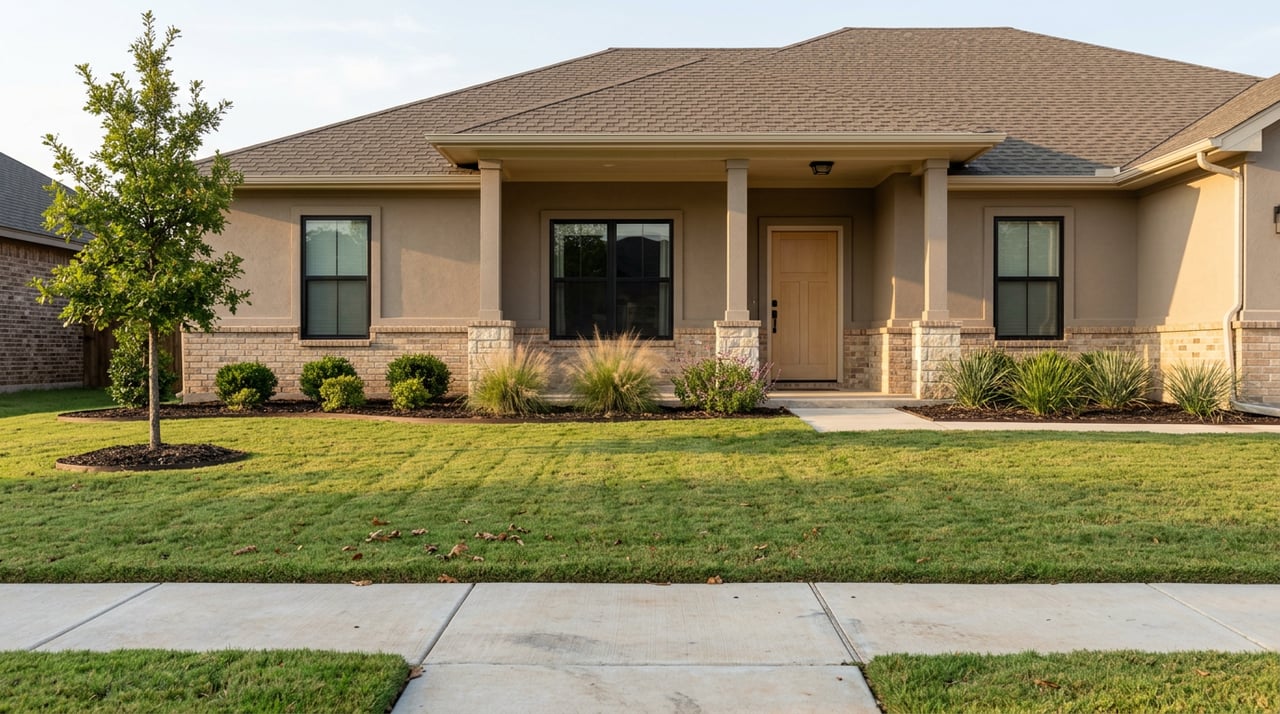
You pull into the sales office at a Leander new-construction community on a Saturday morning. The model home smells like fresh paint. A sales consultant greets you at the door with a clipboard and asks you to sign in: name, phone number, how you heard about the community, and a line for your agent's name if you have one. It takes fifteen seconds. You leave that line blank because you're just looking, and the real decision is months away.
That fifteen-second decision is the one that now matters most.
Most buyers assume the number that decides a new-construction deal in Leander is the incentive check the builder waves in front of them: the rate buydown, the flex cash, the design-center credit. Those numbers matter, and we'll walk through what they actually buy you further down. But the thing that decides whether you have someone advocating for you when those numbers get negotiated is a sequence of paperwork that changed on January 1 of this year, and it now stacks directly on top of a registration policy Leander's builders already had in place.
What Changed in Texas on January 1
Texas Senate Bill 1968 took effect January 1, 2026, and it ended a practice that had quietly shaped buyer relationships for decades. Before this year, a buyer could tour homes, ask for advice, and compare neighborhoods with an agent for weeks without that agent ever being legally obligated to represent the buyer's interests. Without a signed agreement, the agent could technically be a subagent of the seller, meaning any loyalty owed in the transaction ran the other direction.
SB 1968 closed that gap by requiring a written agreement before an agent can show a residential property or present an offer on a buyer's behalf. In practice, that agreement takes one of three forms: the Residential Buyer/Tenant Representation Agreement Long Form (TXR-1501), the Short Form (TXR-1507), or the Unrepresented Customer Showing Form (TXR-1508). Only the first two make you a client with a fiduciary relationship. The third is a compliance document that lets an agent show you a property without representing you at all, and it expires automatically after the showing or after 14 days if no showing happens. The Texas Real Estate Commission's own explainer on the change lays out exactly what shifted this year.
None of this changes what a buyer's agent costs you. In Leander's master-planned communities, builders still typically pay the buyer's agent's fee out of their own marketing budget. What changed is the order of operations. You need a signed agreement in place before the substantive conversation starts, not after.
Leander's Builders Already Had a Rule of Their Own
Long before this year's law, builders in Leander's new-construction communities operated their own version of the same idea. Sales offices across national builders commonly require a buyer to register their agent by name on the first visit. Walk in alone, sign the guest book without mentioning an agent, and some builders will decline to recognize that agent's involvement later, even if you bring them back the following week. Registration windows also vary: some builders honor a registration for 30 days before requiring a refresh, and policies differ enough from builder to builder that the only safe move is to confirm before you drive out to a community.
This isn't a rumor. It's standard enough that real estate education materials built specifically around new-construction transactions warn buyers to bring their agent to the first visit or make sure that agent's name is on the sign-in sheet, because builders view an unregistered visit as a lead they generated themselves.
Where the Two Rules Collide
Here's the part that didn't exist before 2026. Previously, walking into a model home alone meant you might lose a builder's willingness to pay your future agent's commission, an inconvenience but not much more. Now, if you engage with a sales consultant about which lot fits your budget or which floor plan makes sense, that conversation can qualify as representation activity under state law. If you haven't signed anything, you may be asked to sign a TXR-1508 on the spot, a form that gives you access to the property but explicitly withholds advice, negotiation, and loyalty.
That means a buyer can walk out of a Saturday visit having lost two things at once: the builder's recognition of an agent brought in later, and any legal claim that the person walking them through the kitchen was working for them rather than for the builder.
The sequence that protects you against both problems is short:
- Sign a representation agreement with your agent, either the long form or short form, before your first visit to any Leander community, not after.
- Ask your agent to confirm the specific builder's registration policy for that community. Some accept a phone or email registration in advance; others require the agent physically present at the first visit.
- If you've already toured a community without an agent, don't assume the door is closed. Have your agent contact the sales office directly to ask whether a late registration is possible before you visit again.
- Before any conversation about price, lot premiums, or incentives, confirm in writing, even a short email is enough, that the builder's sales office has your agent's name on file.
- Once incentives are on the table, ask your agent to translate the headline number into an actual payment schedule before you compare it to anything else you're considering.
The Incentive Number Everyone Negotiates
Once representation is settled, the incentives themselves need translating. Builders in Leander's communities are stacking several types of incentives at once this year, and each behaves differently once you're past closing.
| Incentive type | Typical range in 2026 | What it actually buys you |
|---|---|---|
| Temporary rate buydown (2-1 structure) | roughly $8,000 to $18,000 | Lowers your payment for the first one to two years, then reverts to the full note rate |
| Permanent rate buydown (discount points) | about 1% of loan amount per 0.25% rate reduction | Lowers the rate for the full loan term, but the cost is often folded into the base price |
| Design center or flex cash credits | roughly $10,000 to $30,000, with at least one Leander builder advertising up to $25,000 as of May 2026 | Spendable inside the builder's design center or toward closing costs, not cash in hand |
| Closing cost contributions | varies, often stacked with the above | Reduces cash due at closing, frequently tied to using the builder's preferred lender |
The math behind a temporary buydown is worth doing before you get attached to the headline number. A 2-1 buydown on a $332,500 loan totals roughly $7,500 in payment relief spread across 24 months. That's real money, but it's not the same as $7,500 handed to you at closing, and if you sell or refinance before the two years are up, you forfeit whatever's left.
Spec homes that have sat complete for 60 or more days tend to carry the richest versions of these packages, because builders managing standing inventory have more room to negotiate than builders selling into strong demand for a specific floor plan. That's a reason to ask when a home was actually finished, not just when it was listed.
The Deadline That Quietly Cancels Half the Savings
Every dollar of incentive assumes you also handle the paperwork on the other side of closing: the homestead exemption. Texas requires the exemption to be filed with the county appraisal district by April 30 of the year after you close. Miss that date and you lose the entire first-year reduction, which on a typical new build adds roughly $115 a month to your effective payment. That's enough to cancel nearly half of what a standard builder rate buydown saved you in the first place. The incentive and the exemption aren't separate line items. They're the same math, and skipping one undoes a chunk of the other.
Reading the PID Line Before You Compare Two Communities
Several of Leander's established communities, including Oak Creek, Deerbrooke, and Crystal Springs, are financed through Public Improvement Districts rather than the Municipal Utility Districts more common in newer master-planned neighborhoods. The city's own PID page shows the Oak Creek district was created July 17, 2014, backed by a $5.2 million bond issued that same year. Deerbrooke followed in 2017, with $8.65 million and $2.535 million in bonds across its north and south improvement areas. Crystal Springs was created in March 2017, with a $5.475 million bond issued the following year.
The detail that catches buyers off guard is how these assessments show up on the bill. PID assessments aren't billed separately. They're folded directly into your consolidated property tax statement, collected by the county tax office alongside city, county, school, and any MUD rate. Nothing on the sticker distinguishes it, which means comparing two communities by their marketed tax rate alone tells you less than pulling the actual assessment roll.
The rate itself also isn't static. In Oak Creek, the combined tax rate moved from 2.3798% for the 2021 tax year down to 2.0384% for the 2025 tax year, with a dip to 2.019% in between. That's not a straight line, and it's a reminder that the rate quoted in a builder's brochure or an online listing reflects a moment in time, not a guarantee. Before you compare carrying costs between two Leander communities, the number worth requesting is the current assessment roll for the specific lot, not the average anyone advertises.
A Few Straight Answers
Do I have to sign something before I can just walk through a model home? Not to walk through it. The obligation kicks in once the conversation moves into advice, comparing floor plans, or discussing what fits your budget. At that point, Texas law requires a written agreement first, either a full representation agreement or a showing-only form that makes clear you're not represented.
What if I already toured a Leander community without an agent? It depends on that builder's specific registration policy. Some builders will still recognize an agent brought in after the fact if you haven't signed a contract. The only way to know is to have your agent call the sales office directly and ask before your next visit.
Does bringing my own agent make the home cost more? No. Builders in Leander's communities generally pay the buyer's agent's fee out of their own marketing budget, the same arrangement that existed before this year's law. SB 1968 changed who is documented as representing you. It didn't change who pays for it.
New construction in Leander rewards buyers who show up prepared, not just pre-approved. If you're weighing a builder incentive against a resale home, or trying to figure out which of Leander's communities actually fits your budget once the assessment roll is accounted for, The Caras Group can walk through the paperwork and the math before you sign anything at the sales office.